

DevOps: Bridging Development and Operations for Agile Growth
Understand how DevOps combines CI/CD, infrastructure automation, and observability to ship faster with more reliable operations.
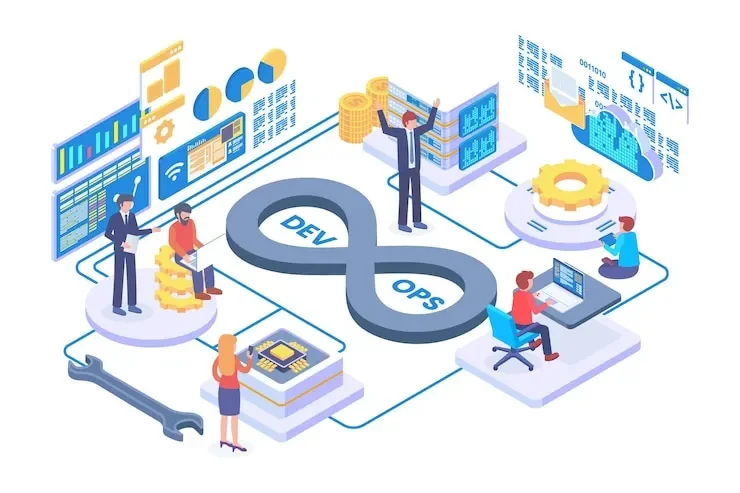
Table of Contents
Delivering high-quality software quickly and reliably is a fundamental requirement for modern engineering teams. However, many organizations struggle with siloed operational structures, manual deployment processes, and unpredictable release cycles. DevOps, the formal integration of software development and IT operations, provides a rigorous methodology to automate workflows, enforce quality standards, and achieve continuous software delivery.
At Datia, we implement DevOps methodologies not merely as a toolchain, but as a structural engineering standard that enables organizations to accelerate feature delivery, minimize systemic downtime, and enforce cross-functional reliability.
1. Defining DevOps in Modern Engineering
DevOps is a technical methodology aimed at unifying software development (Dev) and IT operations (Ops). By enforcing strict automation, systematic monitoring, and shared operational responsibility, DevOps minimizes the friction between application architecture and production deployment. The primary technical objectives include:
- Accelerated Deployment Velocity
- Increased Deployment Frequency
- Reduced Change Failure Rates (CFR)
- Decreased Mean Time to Recovery (MTTR)
2. Core DevOps Methodologies
-
Continuous Integration and Continuous Deployment (CI/CD) The automated compilation, testing, and deployment of code via strict pipelines. Code is integrated and validated against the main repository upon every commit, preventing integration failures and enabling deterministic deployments.
-
Infrastructure as Code (IaC) The programmatic management of infrastructure using declarative configuration files (e.g., Terraform, AWS CloudFormation). This ensures that environment provisioning is version-controlled, reproducible, and mathematically consistent across all stages.
-
Automated Quality Gates and Security Scanning The integration of unit tests, integration tests, static code analysis, and automated vulnerability scanning (DevSecOps) directly into the deployment pipeline to block non-compliant code from reaching production.
-
Comprehensive System Observability The continuous aggregation of operational metrics, logs, and distributed traces (utilizing tools such as Prometheus, ELK Stack, or Datadog) to establish deep visibility into application health and trigger automated alerting protocols.
-
Operational Collaboration (ChatOps) The integration of the deployment and alerting toolchain directly into team communication platforms, enabling engineers to execute deployments, acknowledge alerts, and collaboratively diagnose incidents within a centralized interface.
3. Operational Advantages for Engineering Organizations
The implementation of DevOps practices delivers precise, measurable advantages:
- Deterministic Releases: Automated pipelines eliminate manual execution errors, allowing engineering teams to deploy updates frequently with high statistical confidence.
- Scalable Infrastructure Operations: As traffic scales, codified infrastructure (IaC) and automated orchestration (Kubernetes) adapt dynamically, eliminating the need for manual server provisioning.
- Optimized Compute Expenditure: Automated provisioning allows temporary staging and testing environments to be systematically destroyed when not in use, strictly optimizing cloud resource consumption.
- Accelerated Incident Resolution: Comprehensive observability combined with established incident response protocols allows engineers to identify root causes and execute rollback procedures in minutes.
4. Strategic DevOps Implementation by Datia
Datia provides technical execution and strategic engineering to embed DevOps architectures directly into your organization:
- Architectural Auditing: We execute a formal assessment of your existing deployment architecture, identifying bottlenecks and prescribing a customized DevOps integration roadmap.
- Pipeline Engineering: We architect and implement robust CI/CD pipelines (utilizing GitHub Actions, GitLab CI, or AWS CodePipeline), complete with parallelized testing and automated security enforcement.
- Infrastructure Automation: We develop modular IaC configurations using Terraform and author automated machine image pipelines via Packer to ensure immutable infrastructure deployments.
- Observability Integration: We deploy enterprise-grade monitoring stacks (Prometheus/Grafana) and establish strict alerting matrices to ensure rapid incident detection and response.
- Technical Enablement: We conduct rigorous technical training and pair-programming sessions to transition operational knowledge to your internal engineering staff.
- Continuous Reliability Engineering: We provide ongoing technical support to refine pipeline performance, audit cloud expenditures, and assist with complex incident resolution.
5. Conclusion
DevOps is the structural framework required for rapid technical innovation and high-reliability operations. Transitioning from manual operations to an automated, observable infrastructure is critical for scaling engineering output efficiently.
To architect your organization’s transition to a fully automated DevOps lifecycle, contact Datia for a technical consultation.
Not sure where to start?
Tell us what you need across Web, Cloud, Data or AI. The first call is free and without obligation. You'll talk directly to the engineer who'd do the work.
Related Articles
Mastering Git: Version Control for Modern Development
Learn why Git is the backbone of modern software delivery, from clean branching strategies to auditable collaboration and CI/CD triggers.
Containers: The Key to Modern Cloud Deployments
See how containers improve portability, release speed, and infrastructure efficiency, and when to choose Kubernetes or managed platforms.
Infrastructure as Code for Small Teams
See how Infrastructure as Code helps small teams automate provisioning, eliminate configuration drift, and rebuild environments with confidence.