

AI for SMEs: Five Use Cases That Are Proving Themselves Today
Five AI use cases proven in small and medium-sized businesses – from document processing to customer assistants. Explained in practical terms by Datia.
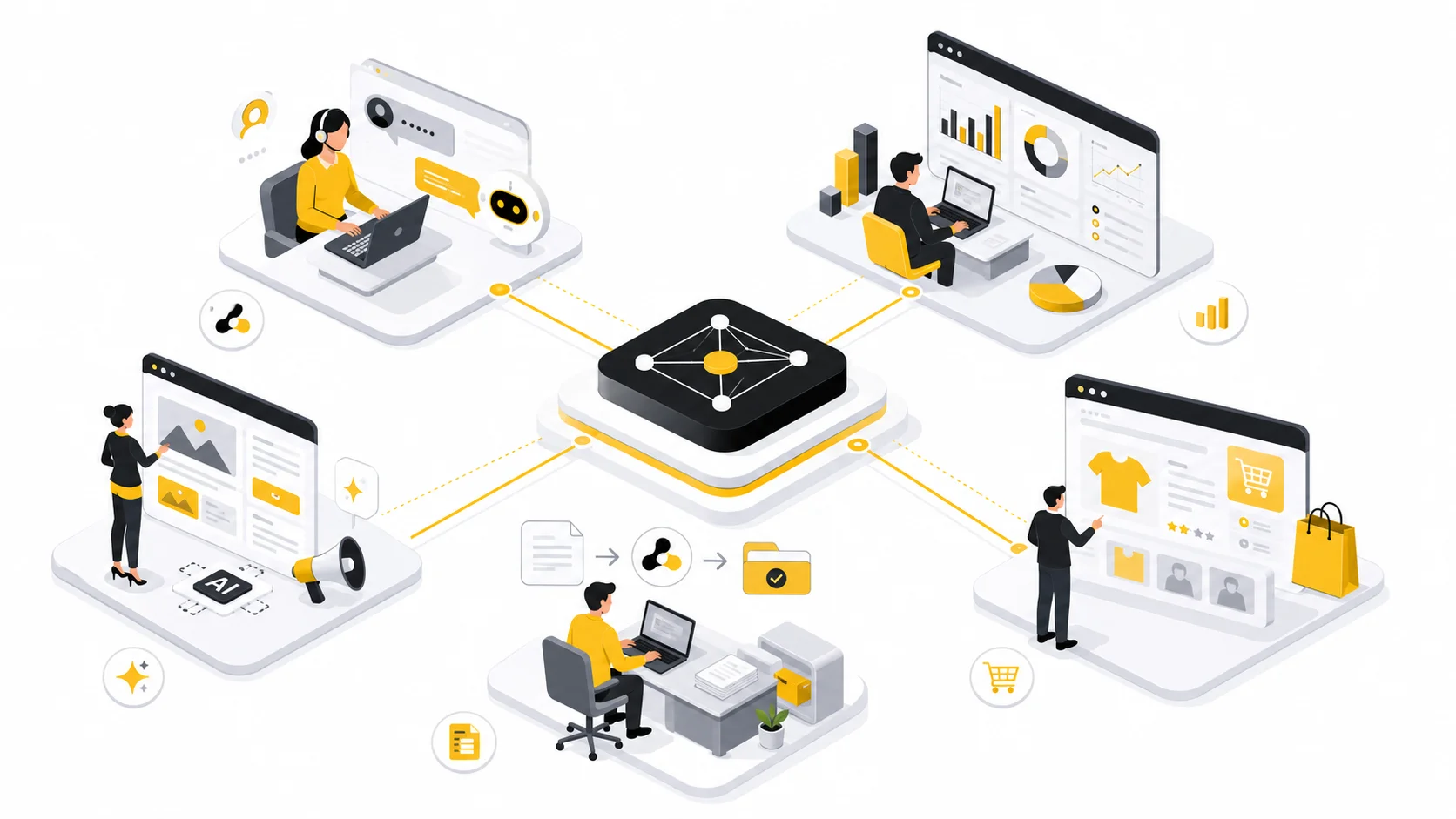
Table of Contents
Artificial intelligence is everywhere in the headlines – but how much of it is actually relevant for an SME in Aargau? The honest answer: less than the marketing promises, and at the same time more than many suspect. The most valuable AI projects in SMEs are rarely spectacular. They take recurring routine work off employees’ shoulders and make existing knowledge usable.
We present five use cases that have proven themselves in practice and describe what matters when introducing them. Datia supports companies in the Lenzburg and Aarau region and across Aargau from the initial idea to productive use.
1. Processing documents automatically
Invoices, delivery notes, orders, forms: in almost every SME, someone is typing information from PDFs into another system. Modern language models read such documents reliably – even when every supplier uses a different layout – and hand the data over in structured form to accounting or the ERP. The effect is immediate: less retyping, fewer data entry errors, faster turnaround times.
2. An assistant that actually knows your customers
A chatbot that only delivers platitudes does more harm than good. It is a different story when the assistant answers exclusively from your own content: product documentation, price lists, FAQs, manuals. The technology behind it is called Retrieval-Augmented Generation (RAG) – for every question, the model receives the relevant excerpts from your documents and answers only on that basis. This lets you handle standard enquiries around the clock and in multiple languages, without anyone working a night shift. The assistant on our own website works on exactly this principle.
3. Drafting texts and quotes in multiple languages
Switzerland is multilingual, and so, often, are your customers. Language models draft quotes, pre-write replies to customer enquiries and translate documentation into good German, French, Italian or English – as a draft that a human reviews and approves. Especially for small teams without their own translation department, this is a tangible lever.
4. Making internal knowledge findable
Over twenty years of company history, thousands of documents accumulate: project folders, minutes, technical records, e-mails. The knowledge is there – but nobody can find it. An AI-based internal knowledge search answers questions like “How did we solve problem X for customer Y?” with a cited source instead of a hit list of 400 files. Particularly valuable when long-serving employees retire.
5. Spotting patterns in your own numbers
Sales forecasts, anomalies in the warehouse, outliers in production data: many SMEs are sitting on data they never analyse. Here it is often less about spectacular AI than about solid data work – consolidating the numbers, cleaning them and querying them with the right models. The transition from classic data analysis to machine learning is fluid; what matters is starting with a concrete business question, not with the technology.
Data protection and control: the Swiss perspective
With each of these use cases, the same question arises: where do our data go? It is a legitimate question – and a solvable one. Models can be operated today so that data stays in Switzerland or in your own cloud environment; the revised Swiss Data Protection Act (revFADP) sets the framework. What matters are clear rules: which data an AI system may see, who reviews the outputs, and where a human makes the decision. Responsible AI does not mean less benefit – it means benefit without losing control.
How to get started successfully
Our recommendation after many of these projects:
- Start with a bottleneck, not with a technology. “Order entry takes too long” is a better starting point than “We need AI”.
- Pilot small and measurably. One use case, one team, four to eight weeks – and define beforehand how success will be measured.
- Keep the human in the process. AI delivers drafts and suggestions; sign-off stays with the experts. That builds trust and catches errors.
- Only then scale. What proves itself in the pilot is extended to further teams and processes – with clean operations, monitoring and governance.
From the region, for the region
AI projects rarely fail because of the technology, but because of a lack of closeness to employees’ everyday work. That is exactly why we work with on-site workshops: we look at the real processes before we talk about models. Datia is based in Lenzburg – for companies around Aarau, Baden, Zofingen and across Aargau, we are quickly at the table.
You can find more about our approach under Artificial Intelligence. Or, even simpler: book a free initial consultation – together we will find out which of these five use cases has the biggest lever for you.
Not sure where to start?
Tell us what you need across Web, Cloud, Data or AI. The first call is free and without obligation. You'll talk directly to the engineer who'd do the work.
Related Articles

The European AI Act: What It Means for Businesses Using AI
The EU AI Act is now the world's first comprehensive AI law, with obligations phasing in through 2027. A practical guide to the risk tiers, the timeline, and what companies – including Swiss ones – need to do.

Claude Code vs Codex vs OpenCode: Choosing an AI Coding Agent
A practical engineering comparison of Claude Code, OpenAI Codex and OpenCode: workflow, model flexibility, security, pricing and how to choose.
Why You Shouldn't Commit to a Single AI Provider
No frontier model leads on price, speed, intelligence and openness at once – and rankings change monthly. The data-backed case for a multi-provider AI strategy.